Celebrating our beautiful boy's anniversary

Happy Gotcha Day, Relay

A great family trip

Our trip to Amherst, VA was amazing.

An easy way to make your own jerky

A DIY project your pups will love.

Set up an email alert for your perfect pet

Use Adopt-a-pet's search saver to let you know when your right pet needs a home.

Let's here it for the boy

I was so happy and incredibly proud.

We do it for all the smiling faces

Dog overpopulation is growing problem in the US and I'm trying to find my way to help.

How Relay became ours

Every dog has a story, and this is how our perfect pound pup came home.

An easy treat

Find directions on how to make one of Relay's favorite treats.

Showing posts with label PSA. Show all posts

June 18, 2012

Questions to ask a rescue Before you foster

Success in fostering is more than getting a dog adopted. The rescue group greatly dictates how positive the experience is, and after a few trials and errors, we now understand that we want to feel that any group we foster for is also the best fit for our family. The rescues we volunteer with now must organized, legitimate non-profits, and have views and principals that align with our own.

We've talked about some examples of not so great groups and we talked about our own follies with our first rescue group.  Now, before we ever sign up to volunteer again, I ask for a phone interview. The following is a list of questions that I have ready so that I can better understand the organization, and to weed out rescues that simply will not work.

Name of organization:_____________________ Telephone:_________________
Website: ___________________ Point of Contact:___________________

Questions about the dogs:
-What type of dogs do you take in?
-How many dogs does your group normally have?
-Where do you typically get your dogs?
-What are your normal intake procedures?
-Do you conduct personality assessments prior to placement in foster care?
-Do you have trainers or support for behavior problems?
-What are your typical adoption fees?

Questions about medical care:
-Do you provide all medical care prior to placing in foster care?
-Do you provide heartworm and flea preventative while in foster care?
-Who is your vet?
-Who is responsible for securing vet care and transport?
-What are the procedures for emergency vet care?
-Do you spay/neuter prior to placing in foster care?

Questions about fostering:
-Do you have a dedicated foster coordinator?
-What do you provide fosters? Food? Collar & leash?
-What are your expectations for foster parents?
-In the event of travel or an incident is there a backup plan for dogs' care?
-How long are dogs typically in foster care?

Questions about the rescue:
-Are you a state registered non-profit / 501(c)?
-Do you have any paid staff?
-What percentage of donations and fees go to dogs?
-Do you have liability insurance?

Questions about outreach:
-Are you active in social media?
-Do you hold events in the community?
-Do you have adoption days? Who is responsible for transport?
-Do you have a relationship with local animal controls?

Questions about adoption:
-Who is your typical adopter?
-Are there any restrictions to people wanting to adopt?
-Are fosters involved in the adoption process?
-How far away do you adopt to?
-What is the policy on 'foster failure'?


This is by no means the end all be all of lists, but it is a great start. Very quickly you'll be able to see any red flags or get a sense that the group could be just what you are looking for. I recently went through this whole process with our next prospective rescue, K9 Justice League, and I just felt so much better. Having a nice long talk with the group I found them to be open, friendly, and sincere in their desire to help dogs find perfect homes. Our next foster will be with them, and we cannot wait to be a part of their group.

April 30, 2012

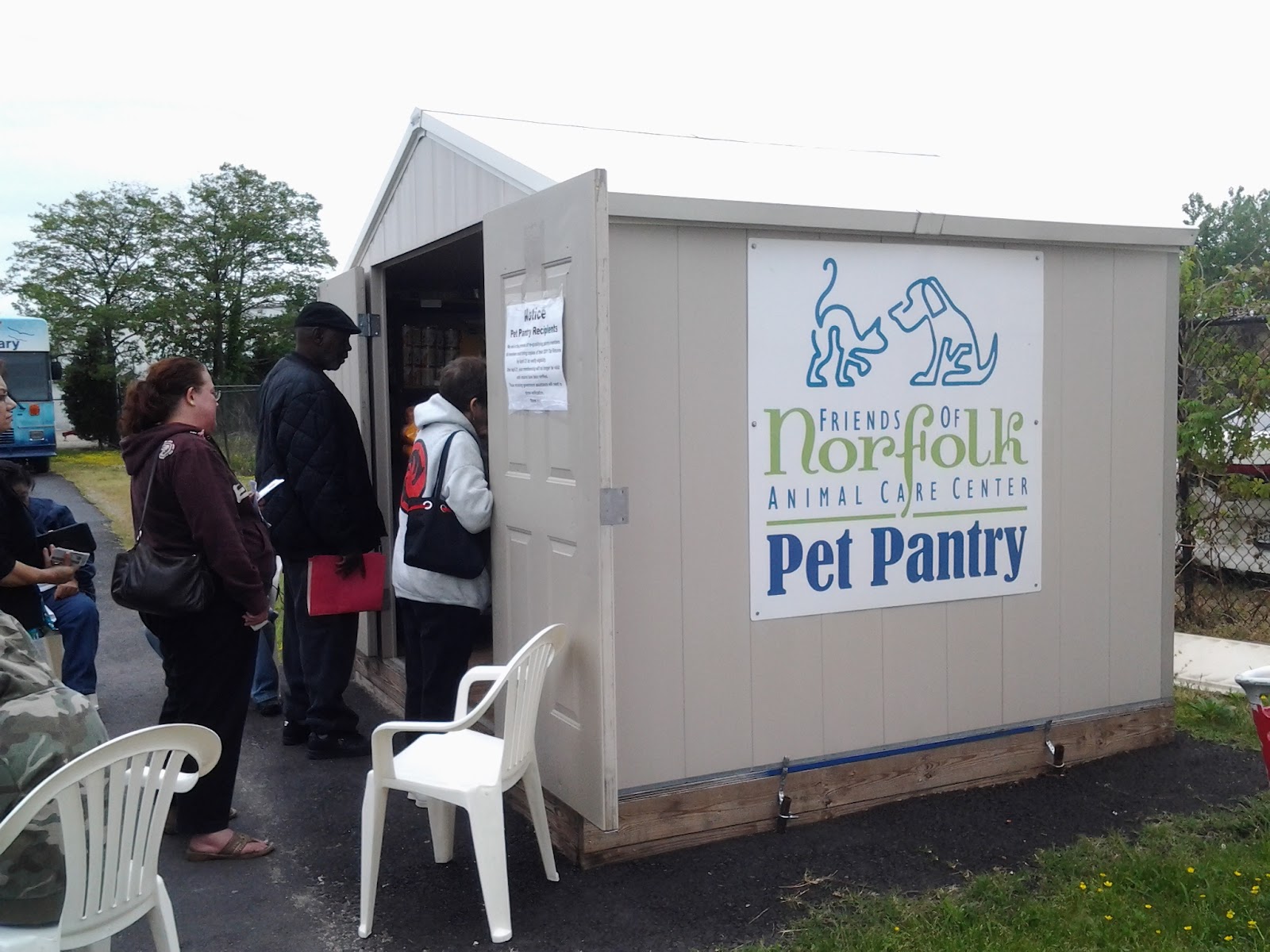
Norfolk Pet Pantry: Helping families stay together

I had the opportunity to stop by and lend a hand for an hour this Saturday at the Norfolk Pet Pantry (located to the side of the Norfolk Animal Care Center). This program is run by the Friends of NACC, a non-profit group lending support to homeless pets and pet families all across Hampton Roads.

While I wait for my next foster assignment, I thought I could try and help out in a different way. The idea behind the Pet Pantry is this: there are some families that are in need here in HR, who are trying to be responsible pet guardians, but cannot afford to feed their pets. Through donations in the community and from retail pet stores, Friends of NACC is able to open a small outlet to help people trying to keep their families together.

It is very evident that there is a need, and that they are doing great things here. People are lined up before the doors open; and there was a steady stream while I was there. It seems like such a simple thing, a bag full of litter, a few bags of kibble, but the impact is huge. People are able to keep their pets and keep them out of shelters, getting by with a little help from the Friends. The program is still in its freshman year, but already they service over a hundred families.

The Pet Pantry is always in need of donations, which can be made directly during operating hours (the second and fourth Saturday each month from 1-4), or at the following stores: PETCO - 4540 Princess Anne Rd # 128, Virginia Beach, PETCO - 5900 East Virginia Beach Blvd, Norfolk, Muddy Paws - 3700 Hampton Blvd, Norfolk. Of if you prefer feel free to donate funds directly to FNACC here.

If your family is going through hard times, you must fill out an application and provide proof of government assistance or your 2011 tax returns showing an income of under $30,000, as well as documentation of spay and neuter for all the pets in the household.

Please, check out their brochure, and send it out so that families in the 757 know that there is help to feed their four legged family.

February 24, 2012

A poster pet for adult adoption

Mr Harley makes this foster thing look easy. Here's a dog that came to us all ready to get into his next home.

-He is fully potty trained; he can comfortably hold his bladder for hours.
-He is leash trained; he walks incredibly and can even jog next to a bike.
-He doesn't climb on furniture.
-He is submissive, and does not bite or snarl at people.
-He knows where his bread is buttered; he is eager to please, and looks for affection.
-He won't wander off; he is content to just sit by your feet.
-He adapts to new dogs quickly.

I had worried about adopting a rescue adult dog, for fear of having to try and rehab unwanted behaviors, but I the case of Harley, he came completely trained, and I wonder if I could have done better. Besides, knowing how many months it took to train Relay, and how much head ache and  trail and error went into that process, who wouldn't want to cut to the good natured and reliable family dog stage?

Ultimately, adult dogs have a harder time finding homes because people often mistakenly feel that they must have done something wrong in order to have been turned in. More often then not, dogs are turned in because of a change in living situations (divorce, move, loss of job), because people were unprepared for the cost and responsibility of dog ownership, a developed allergy, or because the dog was found with no success locating the owner. In none of these circumstances is it the dog's fault.

To set one more at ease, a good rescue will conduct personality assessments, will allow multiple visits and interactions, and, if it should not be a good fit, will accept the dogs back. So, what I'm trying to get at is this: why not give a good dog a look, and forget what his age is? Harley is a dog owner's dream, and at 3 years old he has a whole lot of life left in him.

February 2, 2012

Putting it into perspective- 337

Dog overpopulation. 

Honestly, a year ago I knew nothing about it. Now I find myself preoccupied. The numbers are incredible. It is estimated that 4 to 5 million pets are put down each year in shelters due to overpopulation. That number is insane when you think of it. That's the population of South Carolina. 

The tragic thing is that this is also about the same number of dogs being produced by puppy mills and backyard breeders. So, if the entire country didn't buy a dog for a year, and opted to adopt from their local shelters, if everyone took advantage of low cost spay and neuter clinics, there would be no dog overpopulation.

But I'm not going to be able to reach the entire country with this post, nor will I be able to change everyone's mind even if they did read this. Besides, when you shoot out a number like 5 million, it tends to desensitize people. The number is too big, the problem is too large. That's how I felt, and still feel.

But what about the number 337?  

The Norfolk Animal Control Center is a great pound, but it is capacity controlled. Last year they put down 337 dogs (304 adults, 33 puppies) who were healthy and adoptable. They just ran out of room. 

I can't fix 5 million, but I can try and help out those 337. My Craigslist Project may seem small, but I'm trying to make a difference. Here are the faces of some of the dogs that got adopted in January. They found their happy endings, let's see if we can make some more.

January 21, 2012

SB 610, why it matters, and why Virginian dogs need our help.

Let me introduce SB 610. This bill's patron is Senator Richard Black (R) of Virginia's District 13. This is what worries me. 

Under the new legislation, hunting dogs, working dogs, and show dogs would be reclassified as livestock. By doing so, these animals would fall under the Department of Agriculture, and "The Department occupies the entire field of regulation of the care, control, and handling of agricultural animals. No political subdivision, locality, or humane society shall regulate the care and handling of agricultural animals. "

As innocent as this may seem, this bill opens up the entire animal rights debate, and particular to dogs exposes the constant struggle between animal rights groups and puppy mills, certain hunt clubs, on occasion the American Kennel Club, and others.

Let me begin by stating that supporters of this bill are already eyeing the potential ramifications of this legislation. They are also very well organized.

Dog overpopulation and the euthanasia of pets in shelters has become a nation wide epidemic. One of the principle architects of these problems are puppy mills. This bill would help to provide protections to a mass production of animal abuses.

Further, the inclusion of "Traditional Farm Practices" would potentially allow for dog mutilation for aesthetics and convenience. 

Ultimately, this bill decidedly hampers the ability of any intervention, and puts dogs in danger. From the groundwork of this bill will come a break down of the current limited protection of pets. 

January 9, 2012

When a rescue is not really a rescue

People who buy dogs from breeders or stores can have a hard time sorting out which are puppy mills. Adoption should be a simple decision to ensure that you aren't supporting any bad practices. Turns out there are good rescues and not so good rescues.

The Profiteers:
One of the first rescues I looked into was All American Dachshund Rescue. Any potential surrender had to pay to get their dog vetted prior to turn bringing the dog up to date on shots, get them fixed, etc. Dogs would only be accepted when a foster home was available. As for the potential foster, they required an annual fee for the privilege and the foster covered many medical and associated costs. Finally, they could charge an application fee, a "Health Certificate Fee", and adoption fee often hundreds of dollars from would be adoptive parents.  This 501 "charity" is a very lucrative business. Not only do they have no overhead, they rarely incurred medical bills, and they receive money from the surrender, foster, adopter, donations, and the government. (Sometimes even re-selling a dog) This was no longer about rescue, but about finding out how much people were willing to pay.

Wholesale / Resale:
Certain rescues have been getting into trouble here in the tidewater area. Unfortunately, our neighbor North Carolina has a dog overpopulation problem they can't get under control. Kill shelters are found readily. They are desperate and just give dogs away to anyone who says rescue, whether or not they are legitimate. Some groups drive across the state border pick up the dogs for free or cheap, and then just drop them off with a marked up price. Here in lies the problem. These animals are often not vetted, are not spayed/neutered, and have had no behavior assessments. Adopters or fosters are left to deal with problems, and the rescue readily takes the adoption fee. There is a growing list of complaints against these groups and the business model of get dogs cheap, and get them gone fast.

The Puppymill lite
There are people refereed to as backyard breeders, trying to sell puppies advertising themselves as a rescue. I see them on Craigslist angling for the sympathy vote as well as the lucrative puppy "adoption" fees (often priced two to three times that of an adult dog.) There are also certain rescues who only pull pregnant females from pounds so that they can sell off the pups at 8 weeks. It tends to take the nobility from rescuing when the goal is to save a dog so that it can make you money. But make money they do, and in a very big way. So much so, that "rescues" are bringing in dogs from Mexico just to sell more puppies. Seriously. I recently signed a petition to reign in online pet sales and the White House Response included a note about the importation of sick puppies. I looked into that more and was simply amazed.

Please, please, please, understand that I still completely support my local pound, SPCA, and legitimate rescue groups. "Adopt, Don't Shop" all the way. I just wanted to express this minority of rescues are making the whole process of trying to help just a little harder on me, and I imagine on others as well.

Share

Twitter Delicious Facebook Digg Stumbleupon Favorites More